Bleu – History of My World
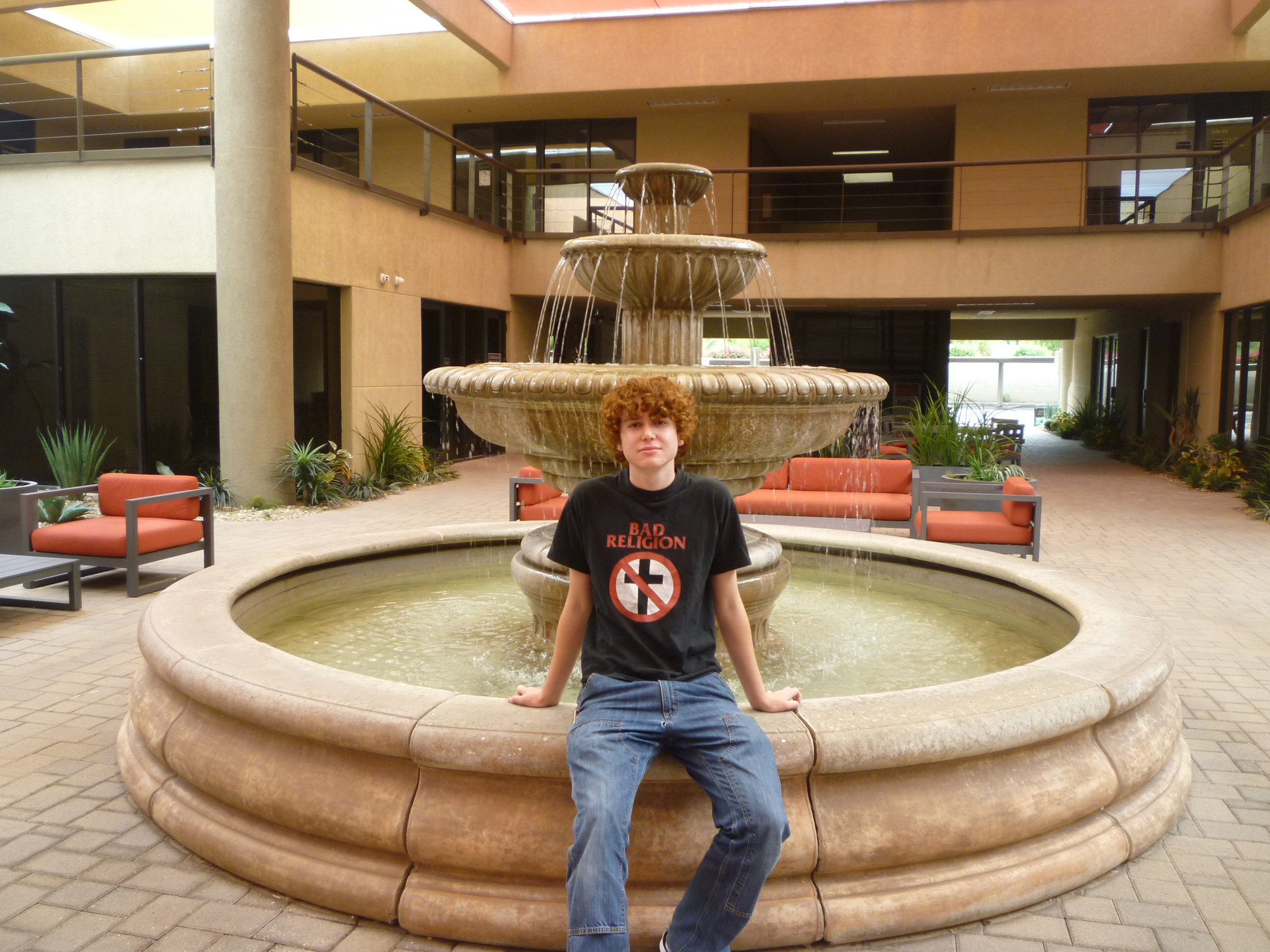
Bleu is a nineteen-year-old architecture student at Scottsdale Community College. I met him in the back of a psychology class.
I met up with him late in September at a medical complex on Shea, a place I had always driven past but never knew what was inside. He was wearing his traditional Bad Religion T-shirt. A door by the entrance read Thrive Therapy, the Intensive Outpatient Program he used to attend. We continued walking until we stopped at a seat in the complex's courtyard, overlooking the fountain.
Bleu was at this complex bi-weekly for "maybe eight months-ish," telling me it was hard to know for sure.
"It all kind of blurs together after a while."
During this eight-month stretch, Bleu was present in two groups. One for OCD, the other for depression, each meeting once a week. There was a strong overlap between the two, he told me.
"Whenever I think of my time in high school, I think of this place. I don't remember much of the classes or the people there, but the kind of people you meet in group therapy and that sort of sphere stuck with me more than anyone I met at school."
"I was always gonna have a deeper connection because I feel like there is camaraderie in a group therapy setting, a shared struggle." He doesn't really talk to anyone from the group anymore. There used to be a life360 and a group chat, but, he told me, "you're supposed to move on with your life."
While outside with other people who were also waiting to be picked up after sessions, he and the others in his group would talk, and it was never small talk. "I think everybody got tired of putting on a performance." Once people had told each other the hardest things to say about themselves, "it's hard to go back to just the weather," he told me. "Some people didn't have much to say, though, not every conversation went deep."
"A lot of people don't have much to say about themselves."
Bleu says he'd still recognize the people from that group if he saw them again, but he wouldn't be able to recognize their different sides. "I only know one side of them, but the therapy side of a person is very interesting." He shared an interesting analogy with me, comparing knowing the therapy side of a person to a game of baseball where "you've skipped past second base, you're all the way to home." Everything surface level had already passed; he already knew why someone was struggling and what they were struggling with. This contrasted with his ordinary life, going to school and seeing people who hadn't shared any of that with each other moving through the hallways.
"I guess there is a rich inner world in each person, but a lot of you don’t have an interesting one."
One of his past therapists, a British man, stood out to him far more than the others. Bleu struggled to explain why; it wasn't anything really specific the therapist said. "He seemed very honest with himself. He didn't play up the role of a therapist too much." Bleu thinks a lot of people in that role carry an ego about it, a feeling that they are "doing a great favor of being your therapist," feeling like a savior for just showing up. This one didn't. "He understood what it meant to talk about something so sensitive to you. It never felt embarrassing or forced."
Bleu doesn't think most people, even therapists, fully grasp what it's like to be a teenager now. "The life of a teenager now compared to a teenager in the 90s or even the 2000s, life is so exponentially different, I don't think they're even comparable." Maybe that's part of why group therapy mattered the way it did, he said.
"People don't talk to each other in general anyway. I feel like group therapy is, at the very least, a good social outing."
"Group therapy was probably good for me."